
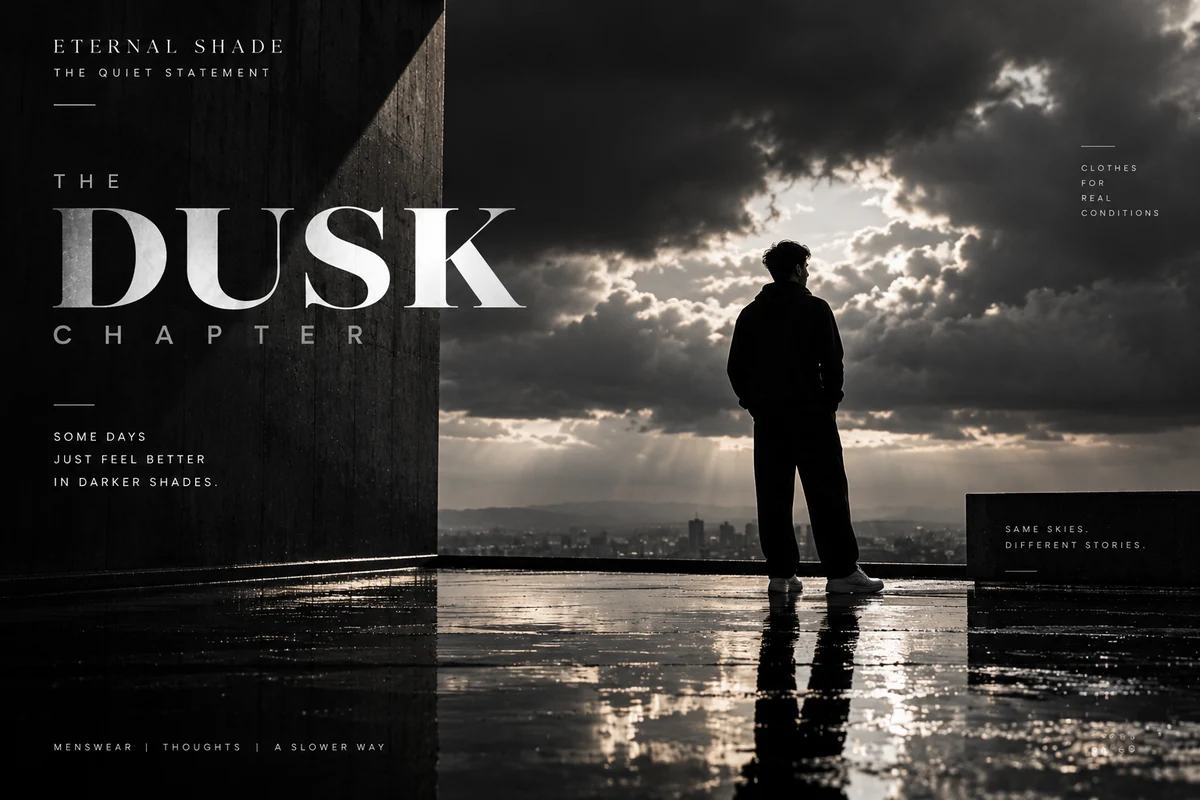
The mood, changing light and quiet psychology behind black menswear.There is something about black after sunset.
The colour has not changed.
The T-shirt is the same.
The fabric is the same.
The person wearing it is the same.
And yet, it feels different. In daylight, black looks clear and defined. You notice the cut of a T-shirt, the structure of a hoodie, the stitching, the surface of the fabric.
Then daylight begins to fade. The sky turns softer. Streets lose some of their colour. Artificial lights appear one by one. Shadows stretch further. Under moonlight or a distant streetlamp, black clothing stops feeling like a colour placed against the world. It begins to feel like part of it.
Black doesn’t disappear into the dark.
It learns how to belong there.
WHEN THE LIGHT CHANGES, SO DOES THE WAY WE SEE BLACK
There is a real visual reason evening feels different from daylight. In brighter conditions, our eyes are better at distinguishing colour. As illumination falls, the way our vision works gradually changes and our perception of colour becomes less rich.
That shift changes what we notice. In strong daylight, colour can dominate the first impression of an outfit. In softer light, other things begin to compete for attention:
the silhouette,
the fall of the fabric,
the difference between matte and smooth surfaces,
the way a fold catches a small amount of light,
the line where the garment ends and the shadow begins.
That is where black becomes interesting. A black T-shirt beneath the afternoon sun may look clean and graphic. The same black T-shirt beneath a streetlight can look deeper, because the eye begins reading it through smaller differences in light, surface and shape. Nothing about the garment needed to become louder. The surroundings simply became quieter.
MOONLIGHT DOESN’T BRIGHTEN BLACK. IT REVEALS IT DIFFERENTLY.
Moonlight is not studio lighting. It does not illuminate every seam, every fold and every detail equally. And perhaps that is exactly why black can feel so natural beneath it. Imagine a black T-shirt outside at night.
Most of the garment sits in shadow. Then a little light reaches one shoulder. The fabric bends and another small highlight appears across a fold. The outline of the body separates from a slightly brighter background. You do not see everything at once.
You notice fragments.
A shoulder.
A fold.
A silhouette.
Then the person.
Black under bright light can be about colour. Black under low light becomes more about form. That subtle difference is part of what gives black menswear such a strong relationship with evenings. Not because black should only be worn after sunset. But because after sunset, another side of black becomes easier to notice.
WHY TEXTURE MATTERS SO MUCH IN BLACK CLOTHING
An all-black outfit can sometimes look incredibly considered. It can also look completely flat. The difference is rarely the amount of black. It is often the amount of visual separation within the black.
Take a heavyweight cotton T-shirt, black denim and a smoother outer layer. From a distance, all three may belong to the same colour family. Up close, they interact with light differently. One absorbs the light quietly. Another shows its weave. Another creates a slight reflection along an edge. This is why texture becomes especially useful when wearing black. If colour is restrained, fabric, weight, proportion and construction have more work to do. A relaxed black T-shirt over structured trousers feels different from the same T-shirt over faded denim. A black hoodie over a black tee creates depth when their fabric weights and silhouettes are different. Even two pieces that are technically black do not have to look identical. And they probably should not.
The best all-black outfits are rarely one uninterrupted block of black.
They are layers of black behaving differently in the same light.
BLACK DOESN’T HAVE TO MEAN ALL BLACK
Wearing black well does not require dressing entirely in black. Sometimes black is strongest when there is contrast around it. Black with white makes the difference immediate.
Black with grey keeps the outfit quieter. Black with washed denim relaxes it. Black beside another deep shade can create a tonal look where the difference only becomes visible when the light catches it.
The point is not to follow a formula. It is to understand what black is doing inside the outfit. Use contrast when you want definition. Keep the palette dark when you want continuity. Mix the two when you want something somewhere in between.
The shade sets the mood.
How you wear it is entirely yours.
BLACK IS THE BEGINNING, NOT THE BOUNDARY.
A darker wardrobe does not have to end where black ends. Look closely at the world around sunset and darkness is rarely pure black.
There is charcoal in concrete. Graphite in clouds. Deep navy in the sky just before night. Dark brown in wet earth and wood. Greys hidden inside shadows. These colours carry some of the restraint of black without trying to replace it. And they change beautifully with light. Midnight navy can appear almost black from a distance, then reveal blue as illumination reaches it. Charcoal stays close to black but creates softer contrast. Graphite sits somewhere between colour and shadow. Deep brown introduces warmth without leaving the darker side of the palette.
For Dusk, black remains the centre. But the idea was never that darkness belongs to one colour alone.
Black is where the story begins.
Not where it has to end.
WHY WEATHER CHANGES THE MOOD OF BLACK MENSWEAR
Clothing is never seen in isolation. The environment becomes part of it. Think about a black outfit against a bright blue summer sky. Now imagine the same outfit on an overcast afternoon. Then imagine rain on the streets, cooler air, grey clouds and the beginning of an early evening. The garment has not changed. The visual world around it has.This is why weather can influence the mood of what we wear. Cloud cover softens harsh light. Wet surfaces reflect the world around them. Winter gives us more opportunity for layers and contrasting textures.Longer evenings change the colours surrounding us. Black does not suddenly become a better colour because the temperature falls. It simply enters an environment where its quieter qualities feel especially at home.
Some clothes match an outfit.
Others seem to match a moment.
IS BLACK ONLY AN EVENING COLOUR?
No.
And that distinction matters. Black works in daylight. It works in summer. It works in winter. It can be casual, formal, minimal or expressive depending on the garment and the way it is worn. Dusk is not a dress code. It is an observation. There are certain moments cloudy afternoons, rain, colder evenings, fading daylight when darker shades seem to speak the same visual language as the world around them. You can wear black whenever you want. But sometimes the surroundings make you notice it differently. That difference is what interests us.
BUILDING A DARKER WARDROBE WITHOUT MAKING IT BORING
Start with the pieces you actually wear. A good black T-shirt is often enough. Then pay attention to what changes when you pair it with different fabrics and colours. Try black against clean white when you want sharp contrast. Pair it with charcoal when you want the transition to feel softer. Use different fabric weights when wearing black on black. Let one piece fit closer while another creates volume. Allow washed and deep blacks to coexist instead of obsessing over making every shade identical. And when you begin adding other dark colours, think of them as part of the same conversation rather than replacements for black. The goal is not to build a wardrobe that looks dark. The goal is to build one where less colour allows more attention to fall on everything else.
The fabric.
The silhouette.
The fit.
The details.
And eventually, the person wearing it.
THIS IS DUSK.

Dusk Chapter began with black menswear because black captures something central to Eternal Shade: restraint without disappearance. It does not need to chase every season. It does not need to become louder to remain present. And as Dusk evolves, deeper shades may enter that world but black remains its first language. Because some colours demand perfect light to be noticed. Black never has. Sometimes, all it needs is less of it.
“कुछ रंग दिन के उजाले में भी खूबसूरत होते हैं,
मगर ढलती शाम उन्हें अपना बना लेती है।”
Different weather.
Different light.
Same you.
Explore the Dusk Chapter black menswear and deeper shades by Eternal Shade.
ETERNAL SHADE
The Quiet Statement.
Leave a Reply